.png)
Cathodic protection
Cathodic Protection against Corrosion
Cathodic protection is typically implemented using to two techniques: passive cathodic protection (with sacrificial anodes) and active cathodic protection (impressed current).
Both techniques aim to bring the average electrochemical potential of a chain of metals to such values that each metal tends to be no longer capable of reacting chemically and turning into an oxide.
This is achieved by inducing a current flow between the sacrificial anode (passive protection) or the electrode (active protection) and the metals to be protected from corrosion.
Cathodic protection has a wide range of applications: from marine applications (nautical, naval, offshore, coastal, industrial, etc.) to land-based applications (water mains, gas pipelines, oil pipelines, etc.), as well as all those applications where specific protection against electrochemical corrosion is required.
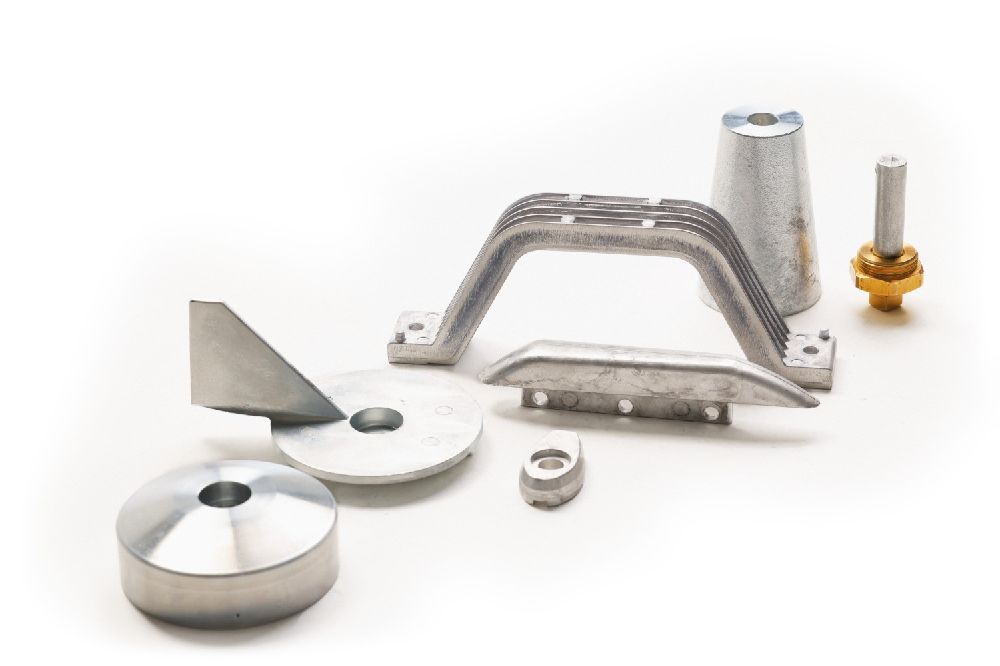
The anodes fitted at specific points on boats form part of a passive cathodic protection system. The principle behind it is very simple: the alloy from which the anode is made, which has a lower electrochemical potential than any of the metals used in the shipbuilding industry, triggers an electrochemical process that causes an electric current to flow from the anode to the cathode (the metal structure to be protected). The migration of electrons from the anode to the structure to be protected enables the anode alloy to react with other substances dissolved in water (OH groups) and transform into soluble or insoluble oxides. This complex process causes the anode to become progressively less efficient over time, until the point at which its replacement becomes essential. The anode’s efficiency is ensured by the inclusion of chemical elements known as activators in the alloy. The other important function of the activators is to fix the anode’s electrochemical potential at specific values on the galvanic series.
Sacrificial anodes do not require a power supply to operate and do not require any special maintenance. The only precaution to take is to replace them in accordance with the schedule correctly specified in the cathodic protection plan.
Sacrificial anodes can be used in: metal-hulled vessels, submerged or semi-submerged metal components, tanks, offshore installations, port facilities, power stations, chemical plants and underground installations.